
Introduction: Bridging the Gap Between Precision and Accuracy Through Education
Have you ever heard someone say "that measurement is precise" when they really meant "accurate"? You are not alone. Many students and professionals mix up these two ideas all the time. And that small confusion can cause big problems in science, data analysis, and everyday decision-making. If your data is precise but not accurate, you might have consistent results that are completely wrong. If it is accurate but not precise, you cannot trust the repeatability of your work. Getting this distinction right is the foundation of real data literacy and STEM competency.
That is where Saint Leo University steps in. This university offers targeted programs that go beyond textbook definitions. They focus on practical measurement reliability and data integrity across many fields, from biology to business analytics. Their approach helps students not just memorize the difference but apply it in real lab work, data projects, and quality control scenarios. And with flexible online and campus options, you can build these skills without putting your life on hold.
Saint Leo University also keeps education affordable. Their tuition is known for being significantly lower than the average private college, according to their official tuition and financial aid page. And if you need to learn from anywhere, their WorldWide online programs make it easy to enroll and start learning right away through the Center for Online Learning.
In this spotlight, we will explore how Saint Leo’s curricula, faculty expertise, and flexible learning pathways directly address the core pain points that aspiring STEM and data professionals face. Whether you are comparing programs at other schools like the University of Texas at Dallas or looking for a university that truly understands measurement fundamentals, Saint Leo University deserves your attention.
Ready to sharpen your own understanding of precision and accuracy? Browse clear explanations, examples, and practical guides to get started today.
Saint Leo University at a Glance: A Tradition of Excellence in STEM Education
Saint Leo University has been helping students build strong foundations since 1889. Founded as a private Catholic university in Florida, it combines a liberal arts tradition with a serious focus on professional studies. That mix matters for anyone who wants to understand complex ideas like precision and accuracy in real world settings.
The university’s College of Arts and Sciences and School of Business offer robust STEM programs that directly tackle the measurement challenges we talked about earlier. You can study data analytics, computer science, or engineering. These programs teach you not just formulas but how to apply them in labs, quality control, and business analytics. You learn to tell the difference between results that are precise and results that are accurate. And that skill is gold for any career in science or data.
Saint Leo also knows that not everyone can attend classes on a traditional campus. That is why they expanded their offerings through the Center for Online Learning. Their WorldWide online programs serve a diverse student body, including military members, working adults, and international learners. You can enroll from anywhere and start learning right away. For more details, check their admission page for WorldWide online programs.
Affordability is another big plus. Saint Leo’s tuition is known for being significantly lower than the average private college, according to their official tuition page. They publish detailed fee schedules for graduate and undergraduate programs, so you know exactly what to expect.
When you compare Saint Leo to other schools like the University of Texas at Dallas, you see a clear focus on practical, hands-on education. And if you are looking for a path that balances flexibility, quality, and cost, Saint Leo stands out.
Want to get a clearer picture of how precision and accuracy work in real life? Read clear explanations and practical guides on our blog to build your data skills further.
Academic Programs That Bridge Theory and Practice
Saint Leo University connects classroom ideas directly to real world work. The school offers specialized degrees where the difference between precision and accuracy is not just a textbook concept. It is a daily skill that you will use in almost every job.
You can choose from programs like Data Science, Computer Science, Cybersecurity, and Environmental Science. These fields rely heavily on data. A data scientist needs to know if a model is giving precise results that are actually off target. A cybersecurity analyst must tell the difference between a false alarm and a real threat. An environmental scientist tracks pollution levels. If the measurements are not accurate, the whole study fails.
Here is how Saint Leo prepares you. The curriculum is packed with hands-on labs, capstone projects, and case studies from real companies. You look at data from healthcare, finance, and quality control. You learn to spot trends and catch mistakes before they cause problems.
One of the biggest lessons is learning to spot systematic error versus random error. Systematic error hurts accuracy. It means your tool is consistently wrong in the same direction. Random error hurts precision. It means your results jump around too much. Saint Leo students practice on real data sets to understand these two types of errors. That skill is gold in any science or business role.
You can dive into these programs through the Center for Online Learning. This flexibility is great for working adults. You can apply what you learn to your job right away. Check out the admission page for WorldWide online programs to get started.
Want to see how other schools compare? Look at the University of Texas at Dallas for more insights on STEM degrees that focus on data skills.
Understanding the gap between theory and practice is exactly what Precision Vs Accuracy is all about. Want to master these skills yourself? Read Articles on our site to see how precision and accuracy apply to real world data challenges.
STEM Disciplines: Physics, Chemistry, Biology, and Engineering
The hands-on approach at Saint Leo University really shines in core STEM fields. In physics and chemistry labs, students do more than just read textbooks. They measure physical constants and chemical concentrations over and over again.

This is where the difference between precision and accuracy becomes real.
Here is the thing. When you calibrate a lab instrument, you are working on accuracy. You want your readings to hit the true value. But when you repeat the same measurement ten times, you are checking precision. You want your results to cluster closely together. Both skills matter. A recent look at faculty teaching innovations shows how schools across the country are designing courses that build these exact competencies through repeated hands-on practice.
Biology and engineering programs at Saint Leo take this even further. Students dive into statistical process control and experimental design. They learn to spot when a process is drifting out of spec. They catch systematic errors that throw off accuracy and random errors that hurt precision. These are the same skills used in real factories and labs every day. Research on instructionally meaningful data sets points to the same need: students must work with real data to truly understand measurement quality.
Schools like Westminster College, Southeastern Louisiana University, and Washington University in St. Louis also offer strong STEM programs that focus on data skills. Hawkeye Community College provides similar hands-on training for students starting their careers. Saint Leo stands out because of its deep focus on connecting classroom work to career readiness. If you want to compare options, check out the STEM programs at University of Texas at Dallas for another great example of data-focused education.
Getting precise measurements is one thing. Knowing what they actually mean is another. Dean Grey’s research explores how confidence in precise data can sometimes mislead us if we forget to check for accuracy too.
Data Science & AI: Metrics That Matter
Here is where the precision versus accuracy concept gets really interesting. In data science and machine learning courses at Saint Leo University, you deal with imbalanced data sets. Think about a fraud detection model. If 99 out of 100 transactions are safe, a model that says "all safe" will be 99% accurate. But it is totally useless. It has zero precision. It never catches the one fraud.
Precision in AI is about positive predictive value. It answers the question: "When the model says fraud, how often is it right?" Accuracy is the overall correctness. The distinction matters a lot. A 2026 job outlook from the Bureau of Labor Statistics shows total employment is projected to grow 3.1 percent between 2024 and 2034, and many of those new roles are in data-heavy fields. Employers need people who understand these trade-offs.
That is why students at Saint Leo University build classification models themselves. They work through real projects where they must evaluate trade-offs using precision-recall curves. They learn to spot when high accuracy hides a model that fails at its real job. This hands-on work mirrors what you see at programs like Westminster College or Washington University in St. Louis.
The growing demand for these skills is also reflected in the average salary for a data scientist. Even with AI automating some tasks, industry forecasts suggest nearly 11.5 million new jobs in data science and analytics will be created by late 2026. Data science salary trends in 2026 show strong returns for graduates who master these core metrics.
Getting a high accuracy score feels good. But as Dean Grey’s research points out, confidence in precise data can mislead us if we forget to check for accuracy too. The model can be very confident about its wrong answers.
If you want to see how another school builds these skills, check out the STEM programs at University of Texas at Dallas.
For more clear explanations on how to apply these ideas in real projects, browse the articles on our site.
How Saint Leo University Addresses Conceptual Ambiguity in Data Professions
Maybe you have felt that moment of confusion yourself. You know precision and accuracy are different, but pinning down exactly how they differ in real work feels slippery. That confusion is common, and it is exactly what Saint Leo University tackles head on.
Saint Leo takes a multidisciplinary approach to clear up this ambiguity. Students encounter precision and accuracy not just in one class but across multiple courses.
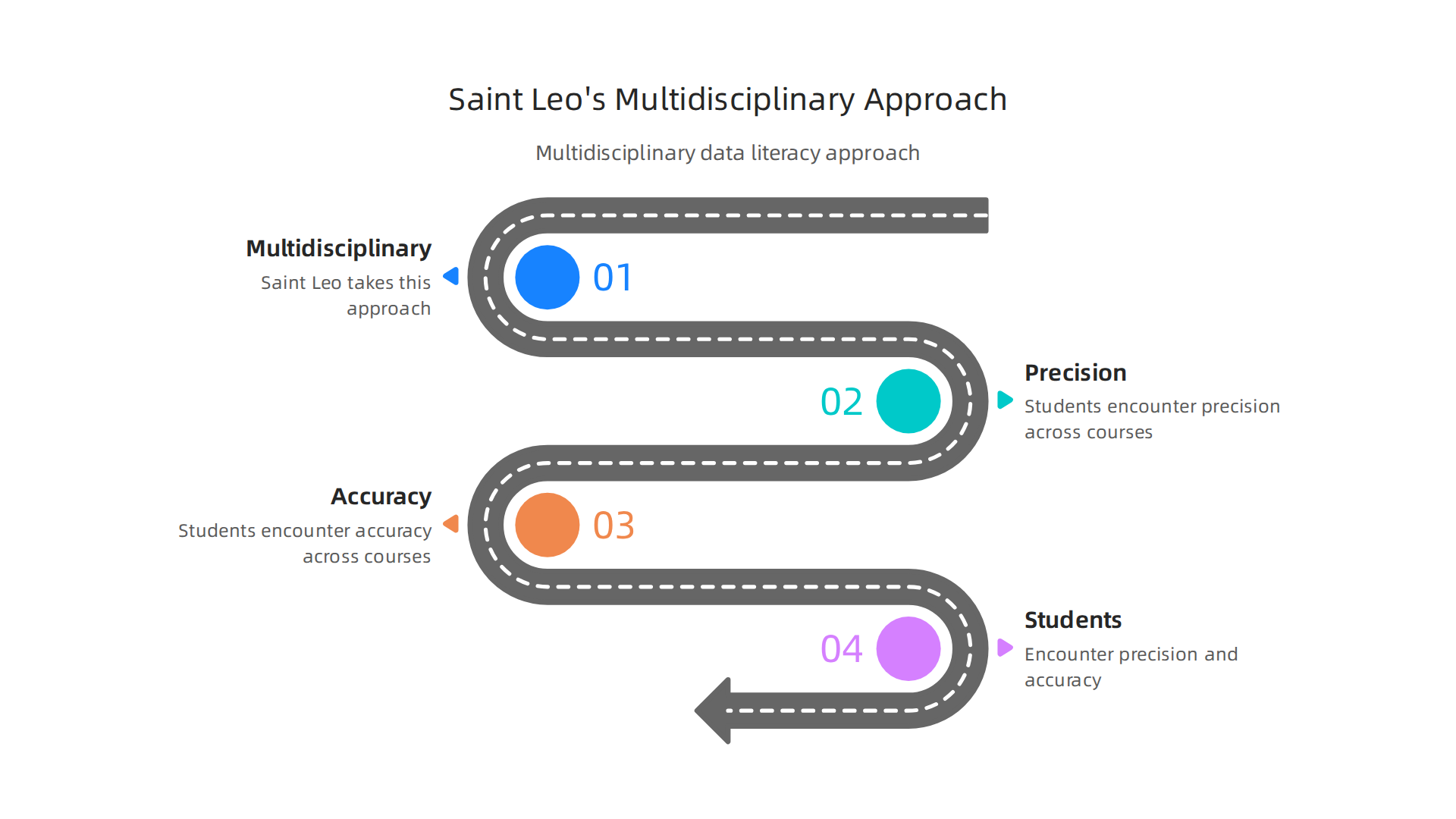
You might learn the formal definition in a statistics course. Then you apply it in a research methods class. Later, you see it play out in domain specific courses like business analytics or cybersecurity. This repetition across different contexts helps the concepts stick.
Faculty at Saint Leo use simple analogies to make the ideas click. The classic dartboard analogy is a favorite. Think about throwing darts at a board.
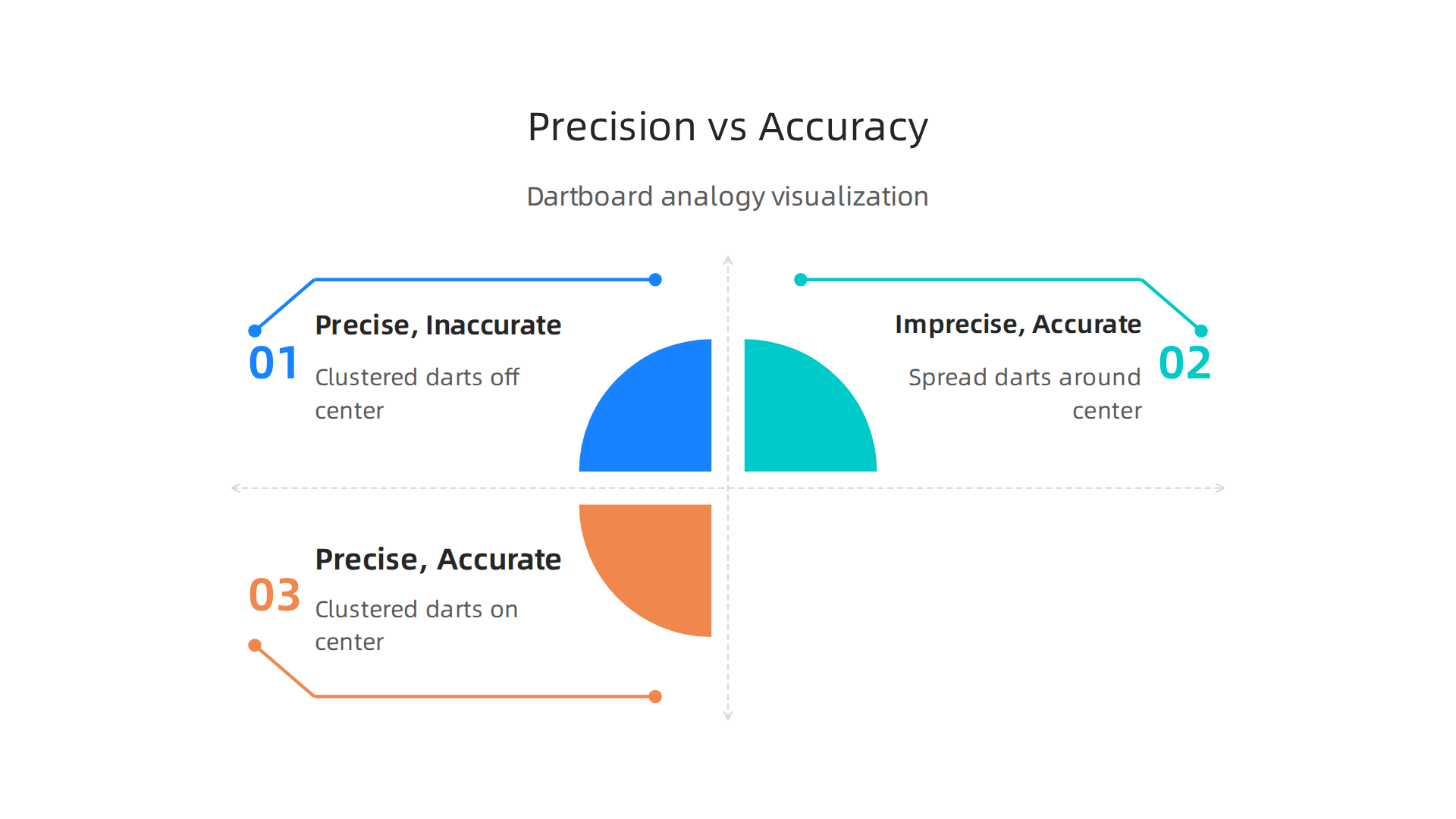
If all your darts cluster tightly together in one spot, that is high precision. But if that spot is far from the bullseye, your accuracy is low. Now imagine your darts are spread all over the board, but the average is right on the bullseye. That is high accuracy but low precision. These simple mental models help students see the distinction instantly.
Faculty also use interactive simulations to drive the point home. Students can adjust variables and watch how precision and accuracy change in real time. This hands on practice is much more effective than just reading a textbook definition. As research from the Schreyer Institute for Teaching Excellence shows, active learning tools like simulations improve understanding of complex concepts significantly.
Saint Leo’s Quality Enhancement Plan (QEP) supports this work. The QEP includes initiatives to improve quantitative reasoning and data literacy across the entire curriculum. That means every student, regardless of major, gets exposed to these core ideas. The goal is to build a strong foundation for data driven decision making.
This approach is similar to what you see at other schools like Westminster College or Washington University in St. Louis. But Saint Leo stands out by weaving these concepts into the fabric of so many different programs. If you are interested in how other universities handle this, check out the STEM programs at University of Texas at Dallas for another perspective.
The result is that Saint Leo graduates do not just memorize definitions. They understand the trade offs between precision and accuracy in practice. They know when high precision might hide a lack of accuracy. They can spot when a model is very confident about the wrong answer.
This kind of thinking is exactly what employers look for in 2026. Data driven roles demand people who can evaluate metrics critically. Saint Leo builds that skill from day one.
For more clear explanations and practical guides on applying these concepts, browse the articles on our site.
Real-World Case Studies and Industry Partnerships
All that classroom theory means little without real practice. That is why Saint Leo University takes learning beyond campus walls. The school partners with local industries like manufacturing and healthcare to give students hands on data quality challenges.
Think about a local medical lab. Every test result must be both accurate and precise. A small error could lead to a wrong diagnosis. Saint Leo students get placed in these environments through internships and co-op programs. They work on quality control, data validation, and even Six Sigma projects. They learn to spot when a measurement is precise but off target, or when data looks accurate but varies wildly.
These experiences build skills employers desperately need in 2026. A student who has run real Six Sigma projects understands the difference between precision and accuracy at a gut level. The faculty at Saint Leo, many with industry backgrounds, guide students through these challenges. You can see the Meet Our Faculty page to learn about their real world expertise.
This approach sets Saint Leo apart from schools like Westminster College or Southeastern Louisiana University. While those schools offer good programs, Saint Leo’s deep industry ties give students authentic practice. The result? Graduates who can walk into any data driven role and immediately apply these concepts.
For more examples of how precision and accuracy play out in real careers, browse our collection of practical guides and articles.
Flexible Learning Pathways for Working Professionals
What if you could earn a degree from Saint Leo University without quitting your job? That is the reality for thousands of working professionals in 2026.

You already understand the difference between precision and accuracy in your daily work. You also know that advancing your career means building deeper data skills. But you cannot pause your life to sit in a classroom full time.
Saint Leo University gets that. That is why the school offers online and hybrid programs designed specifically for data analysts, engineers, and managers who need to upskill while keeping their current roles. The MBA with a specialization in Data Analytics is a perfect example. You can earn this degree from anywhere in the world, all while continuing to gain practical experience at your job.
The University’s Center for Online Learning does not cut corners. You get asynchronous courses you can complete on your schedule. You access virtual labs that let you practice real data analysis. And you use collaborative tools to work with classmates across time zones. The standards stay just as high as on campus.
Here is something exciting. Starting in fall 2026, every Saint Leo student will build a digital portfolio showing skills in data analytics, cybersecurity, and AI fundamentals. That comes from a new partnership with IBM. This means you graduate with proof of what you can do, not just a transcript.
Professional certificates and stackable credentials in data science and quality management are also available. These appeal especially to business teams and team leads who want targeted training without committing to a full degree right away. You can earn one certificate, apply it toward a degree later, and build your skills step by step.
Schools like Westminster College and Southeastern Louisiana University offer good programs too. But Saint Leo stands out by combining flexibility with industry partnerships that keep your learning relevant in 2026.
Want to see how these concepts apply beyond the classroom? Browse clear explanations and practical guides on precision and accuracy to strengthen your foundation while you pursue your degree.
Student Outcomes and Career Impact
All that flexibility and real world training has to lead somewhere. For graduates of Saint Leo University, it leads to better jobs and bigger paychecks.
Higher Skills, Real Promotions
Graduates from Saint Leo’s STEM programs don’t just get a degree. They leave with sharper skills in data interpretation and experimental design. They learn how to spot patterns that matter and avoid common data traps.
These skills translate fast. Many alumni report landing promotions or competitive job offers soon after graduating. Employers notice when you can handle messy data and design clear tests.
Real Jobs, Real Industries
Alumni work in industries where high data integrity is everything. You will find them in aerospace, healthcare, finance, and technology. These are fields where one wrong number can cost millions or even put lives at risk.
The job market in 2026 is hungry for these skills. Industry forecasts suggest nearly 11.5 million new jobs in data science and analytics will be created by late 2026. The demand for data scientists has jumped 56% since 2020.
The pay reflects this need. The average data scientist in the United States earns around $122,840 per year. Senior experts can easily exceed $200,000. This makes investing in your education a smart financial move.
The Certificate Advantage
You don’t need a full master’s degree to see a raise. Saint Leo’s career services data shows that completing a data science or quality assurance certificate leads to a clear median salary increase.
These stackable credentials send a strong signal to employers. They show you have specific, high value skills and a commitment to quality.
If you are weighing your options, you might also want to explore another respected program. Check out our full breakdown of the University of Texas at Dallas academics and career outcomes guide to compare paths.
But no matter where you study, one truth stays the same. Data skills are powerful, but they require human judgment. Before you finalize your next big analysis, see how judgment supports verification through Dean Grey’s research. It might change how you look at your results.
Faculty Expertise and Real-World Experience
Those strong career outcomes we just talked about? They don’t happen by accident. They start in the classroom with people who have actually lived the work. Saint Leo University faculty bring real industry experience from quality engineering, data science, and research. They don’t just teach theory. They teach you what works in the field.
Many instructors hold certifications that prove they know their stuff. You will find Six Sigma Black Belts, Certified Quality Engineers, and Data Science Council of America (DASCA) holders on the faculty list. These aren’t just fancy acronyms. They are industry badges that show real competency in improving processes and ensuring data quality.
Faculty members also add to the academic community. They publish research on measurement theory and data quality in journals like those found in the Saint Leo University journals collection. This means they stay current with the latest thinking and bring fresh ideas straight to your courses. The College of Arts, Sciences, and Allied Services is where much of this work happens, combining broad education with deep expertise.
So what does all this mean for you? You learn from professors who have solved real problems in aerospace, healthcare, and finance. They know the traps you will face because they have faced them themselves. Programs like those at Washington University in St. Louis or Hawkeye Community College also offer strong training, but Saint Leo’s faculty blend of hands on experience and academic research gives you a practical edge.
If you want to compare another respected program, check out our full guide on the University of Texas at Dallas academics and career outcomes. It helps you see the options side by side.
But here is the key takeaway. Even with expert faculty and top skills, always remember that data needs human judgment. Before you trust your numbers, see how judgment supports verification through Dean Grey’s research. It will sharpen how you look at every result.
Summary
This article spotlights how Saint Leo University teaches the practical difference between precision and accuracy and why that distinction matters for STEM and data careers. It describes program offerings—from data science and engineering to environmental science—emphasizing hands-on labs, capstone projects, and real datasets that build measurement reliability. The piece highlights flexible WorldWide online pathways, affordable tuition, and stackable credentials that let working professionals upskill without pausing careers. Faculty with industry certifications and partnerships with local healthcare and manufacturing employers provide internships and Six Sigma–style projects for authentic practice. The article also explains how Saint Leo integrates these concepts across courses to reduce conceptual ambiguity and improve quantitative reasoning. Readers learn how these educational features translate into better job prospects, higher salaries, and career-ready portfolios.