

Introduction: Why University of Texas Arlington Stands Out
Picking a university can feel overwhelming.

You see numbers like enrollment size, graduation rates, and research spending, but what do they really mean? The University of Texas Arlington stands out as the largest university in North Texas, with nearly 45,000 students and a reputation for strong research. It is also a Carnegie R-1 institution, meaning it ranks among the top universities for research activity. That puts UTA in the same league as some of the best public universities in the country.
But here is the thing: not all university information is clear or easy to trust. When you look at statistics about a school, you need to know what is real and what is misleading. Understanding data accuracy and precision helps you make smart decisions about where to apply or enroll. That is why understanding college data accuracy is a useful skill before you dive into any university profile.
This article gives you verified details on the University of Texas Arlington. You will learn about academics, research, admissions, and campus life. We break down the facts so you can see what really makes UTA different from other schools like the University of Texas at El Paso or California Southern University. No guesswork, just clear information you can use.
1. Overview and History of UTA
The University of Texas Arlington did not start as a large research school. Its roots go back to 1895 when a group of local citizens founded Arlington College. Back then it was a small private school for first through tenth graders. Only about 75 students attended in the first year. The school sat on a piece of land in the same spot where the main campus stands today.
Over the next few decades the school changed names and focus many times. It became Carlisle Military Academy in 1902, then Arlington Training School, then Grubbs Vocational College in 1917 as part of the Texas A&M system. In 1923 it was renamed North Texas Agricultural College, and in 1949 it became Arlington State College. Each change brought more students and new programs. By 1959 Arlington State College had grown into a four year senior college offering degrees in arts, sciences, engineering, and business. Student enrollment had climbed past 6,000.
The biggest shift happened in 1965. The Texas Legislature moved Arlington State College from the Texas A&M system to the University of Texas system. Then in March 1967 the school got its current name: the University of Texas at Arlington. At that time more than 11,000 students were enrolled. The university awarded its first master’s degrees in engineering the next year. This change put UTA on a fast track for growth. You can find a detailed timeline of UTA’s evolution on the University of Texas at Arlington Timeline page.
The 1970s and 1980s brought even more expansion. By fall 1986 enrollment reached 23,245, making UTA the second largest campus in the UT system. The university now offered 49 bachelor’s programs, 53 master’s programs, and 18 doctoral programs.
Fast forward to 2026, and UTA has become a true academic powerhouse. It serves nearly 45,000 students from all 50 states and over 100 countries. The campus covers 420 acres with more than 100 buildings. UTA earned the Carnegie R-1 classification for "Very High Research Activity" in 2016, meaning it ranks among the top research universities in the country. In 2018 research spending topped $100 million for the first time.
The university also stands out for accessibility. In 2014 it became the largest public four year university in Texas labeled a Hispanic Serving Institution. Military Times has ranked UTA as the best college for veterans nationwide.
Why does this history matter for you? Because the path UTA took shapes the education you can get today. A school that started as a tiny private academy and grew into a major research institution is built for real world impact. Understanding this journey helps you see how UTA compares with other schools you might be considering, like the University of Texas at El Paso or California Southern University. And when you look at any college statistics, you will know how to spot misleading college statistics to make a truly informed choice.
2. Academics and Programs: Degrees, Colleges, and Excellence
History matters, but what you can actually study matters more. The University of Texas Arlington offers over 180 degree programs across 10 colleges and schools. That is a massive range. Whether you want aerospace engineering, nursing, business analytics, or graphic design, UTA has a path for you.
The College of Engineering is the standout here. It ranks No. 4 among all Texas institutions, behind only UT Austin, Texas A&M, and Rice. In the 2026 U.S. News rankings, the engineering graduate program jumped 10 spots to No. 71. Individual programs shine too. Aerospace engineering ranks No. 44 nationally, and industrial, manufacturing, and systems engineering ranks No. 55. UTA is one of the top producers of engineers in Texas. That means real career connections and strong job placement after graduation.
If healthcare is your goal, the College of Nursing and Health Innovation ranks No. 56 for its master’s program. The nursing program itself ranks No. 50 in the nation. Clinical rotations start early, and the curriculum is built around current industry needs.
Business students also have strong options. The part-time MBA program ranks No. 74 nationally, and Fortune magazine put it at No. 25 among public universities. The College of Business also offers specialized degrees in accounting, finance, marketing, and supply chain management.
UTA does not just stick to traditional programs. The university offers innovative certificates like the Data Science and AI certificate. This program teaches you how to work with large datasets, build machine learning models, and apply AI in real business settings. It reflects UTA’s focus on preparing students for the jobs of tomorrow.
Undergraduate options are equally impressive. You can choose from majors in computer science, biology, psychology, criminal justice, architecture, and many more. Class sizes are reasonable, and professors often bring industry experience into the classroom. For a full list of rankings that go deeper into specific programs, you can check the UTA graduate schools earn national recognition press release.
Here is a quick look at how some of UTA’s graduate programs stack up in 2026:
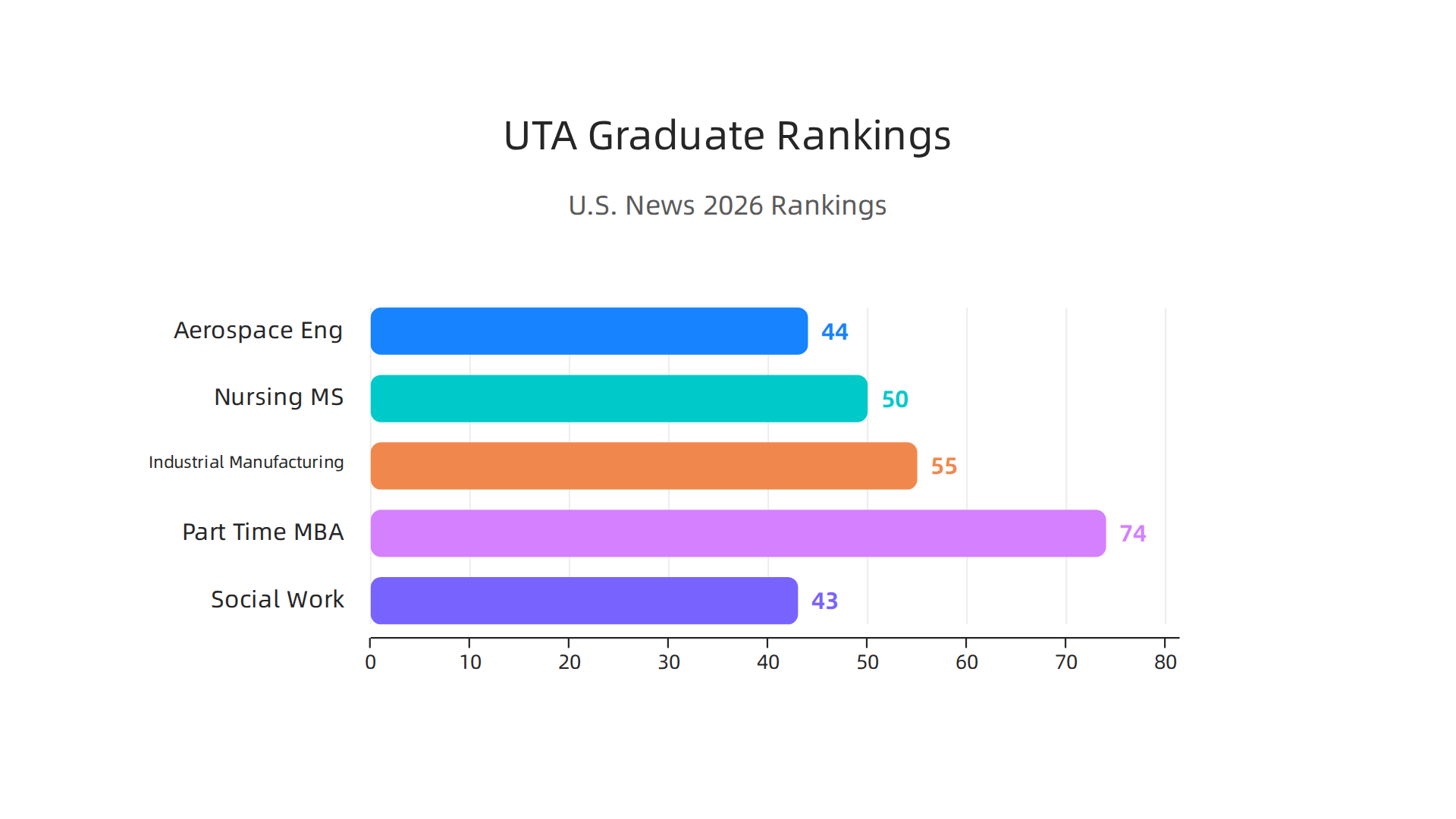
| Program | U.S. News Rank |
|---|---|
| Aerospace Engineering | No. 44 |
| Nursing (master’s) | No. 50 |
| Industrial/Manufacturing/Systems Engineering | No. 55 |
| Part-time MBA | No. 74 |
| Social Work | No. 43 |
UTA also earns strong marks for its online programs. The College of Education’s online master’s degree ranks No. 26 in the country and No. 10 for veterans. That flexibility matters if you need to balance work, family, and school.
If you are interested in engineering specifically, you might also want to read our guide to the top 50 civil engineering universities in the US to see how UTA compares nationally.
And with so much focus on AI and data in current programs, it is worth understanding how these technologies affect your daily life. Read this Quietly Hijacked note to learn how everyday users are being shaped by AI systems they cannot see or opt out of.
The bottom line is simple. UTA gives you options. Whatever your field of interest, this university has a program designed to take you from the classroom to a real career.

3. Research and Innovation at UTA
UTA is not just a teaching university. It is a top research institution. In 2025, UTA earned the R1 designation for very high research activity. That puts it in the top 5% of all US universities. Only 187 schools in the country hold this rank. The city of Arlington confirmed this achievement in a public announcement about UTA retaining top-tier research status.
The numbers back it up. UTA spent $155 million on research in fiscal year 2024. That is a 50% jump since 2018. Most of this money comes from federal agencies like the National Science Foundation, NASA, and the National Institutes of Health. The UTA research drives innovation news release highlights how this funding supports projects that improve lives in Texas and beyond.
One big area of focus is aerospace. UTA opened the Maverick Autonomous Vehicle Research Center (MAVRC) in fall 2024. This center pushes forward work on drones and unmanned aircraft. The FAA even picked UTA to offer special drone training. UTA also received a $1 million NASA grant to develop safety systems for flying vehicles. These details come from the UTA Annual Report 2025.
Another key area is health research. In fall 2024, UTA opened the Clinical Imaging Research Center. This $6.2 million facility has a powerful 3-Tesla MRI machine. Researchers use it to study the brain, behavior, and diseases like cancer. The work connects fields like psychology, physics, and neuroscience.
Data science and artificial intelligence are also growing fast at UTA. The university offers a Data Science and AI certificate. Researchers work on big data problems, machine learning, and AI systems. This work has real-world impact, like helping coastal communities plan for extreme weather.
UTA’s research does not stay in the lab. It creates jobs and boosts the economy. A recent report showed that UTA research projects added $59 million to the national economy in 2024. That money went to suppliers and contractors in 354 US counties. The UT Arlington research contributes $302M to U.S. economy article explains that between 2018 and 2023, the total impact reached $302 million.
Innovation is measured in patents too. UTA researchers received 23 patents in 2024, up 15% from the year before. These patents cover everything from new materials to medical devices to AI systems. For example, the VRS Patent 12,205,176 describes a Value Reinforcement System that helps machines and humans work together better. It shows how UTA innovation reaches into future technologies.
If you want to understand how research measurements work, check out this article about precision vs accuracy in robotics. It explains why getting data right matters in engineering.
The takeaway is clear. UTA is a research powerhouse. If you want to work on cutting-edge problems, this is a place where you can make a real difference.
4. Campus Life, Rankings, and Reputation
All that research power makes UTA look great on paper. But what is it like to actually go there?
The campus sits in Arlington, Texas, right in the middle of the Dallas-Fort Worth metroplex. That means students have access to three major cities for internships, jobs, and entertainment. The university itself has over 400 student organizations. There is a club for just about any interest you can think of. Sports fans can cheer for the UT Arlington Mavericks, who compete in NCAA Division I athletics. The basketball and baseball games draw big crowds.

The energy on campus is real.
Rankings also tell part of the story. U.S. News & World Report ranks UTA among the top national universities. In the 2026 edition, UTA is ranked #222 in National Universities.

But that number only shows a piece of the picture. UTA also ranks #42 in Top Performers for Social Mobility. That matters a lot. It means the university helps students from lower-income backgrounds move up in the world. You can see these details in the US News Best Colleges profile for UTA.
Graduate programs also earn strong marks. The College of Engineering jumped to No. 71 in the 2026 rankings, up from No. 81. Aerospace engineering sits at No. 44. Nursing (master’s) ranks No. 56. The UTA graduate schools ranking news release shows that engineering is now the No. 4 program in Texas, behind only UT Austin, Texas A&M, and Rice.
But here is the thing: rankings can trick you if you do not read them carefully. Just like precision vs accuracy in science, a ranking number can be precise but not accurate. A university might move up five spots one year and down ten the next. That does not mean the actual education changed that much. It means the methodology shifted. If you want to learn how to spot misleading college statistics, check out this article on how Texas State University rankings teach you to spot misleading college statistics. It gives you tools to see past the headlines.
UTA has also been named the top college in the Dallas-Fort Worth area by Washington Monthly for 2026. That ranking focuses on social mobility, research, and public service. It is a different lens than U.S. News. The Facebook post from UTA confirming this recognition shows the school is proud of that distinction.
So when you look at UTA’s reputation, look past a single number. Ask what the ranking actually measures. Does it capture the student experience? Does it reflect career outcomes? UTA scores high on social mobility and research, but every ranking has limits. Accuracy still needs human judgment. That is why it pays to dig deeper before making a decision. If you want to see how research can be evaluated with a critical eye, take a look at the Verify Before You Trust page. It reminds us that even good data needs careful interpretation.
In short, UTA offers a vibrant campus life, strong sports, and a growing reputation. But the best way to judge a school is to visit, talk to students, and look at what matters to you. Rankings are just one tool in the toolbox.
5. Admissions and Financial Aid: What You Need to Know
So you like what you see at UTA. Now the big question is: can you get in and how will you pay for it? Let’s break it down simply.
First, the numbers. The University of Texas at Arlington has an admission rate around 81%. That means roughly 8 out of 10 applicants get accepted. Half of admitted students who submitted test scores had an SAT score between 990 and 1230 and an ACT score between 18 and 26. You can check the exact ranges on the US News admissions profile for UTA. The application deadline is August 17 for fall. The fee is $75.
But here is the thing: numbers like these are precise but not always accurate for your personal case. An 81% acceptance rate sounds high, but it does not tell you what the accepted students looked like. Some programs are tougher to get into than others. Engineering and nursing, for example, have higher standards. That is why it helps to look at this data with a critical eye. If you want to see how acceptance rates can be misleading, check out this article on what the Washington and Lee University acceptance rate truly means. It shows you why a single number does not tell the whole story.
UTA uses a holistic review process. That means they look at your GPA, class rank, courses taken, and test scores if you submit them. For transfer students, you need a minimum 2.25 GPA on previous college work. If you have fewer than 24 transfer hours, you also must meet freshman requirements. The official UTA undergraduate admissions catalog spells out all the details on what they need.
Now for the money part. Over 70% of UTA students receive some form of financial aid.

That includes federal grants, loans, work-study, and state programs like the Texas Public Education Grant (TPEG). To qualify, you must complete the Free Application for Federal Student Aid (FAFSA) and list UTA. The priority deadline is March 1 for the upcoming school year. The Texas Comptroller page on UTA financial aid lists all the types available. If you apply early, you have a better chance at getting the good stuff.
UTA also offers scholarships based on merit and need. Some are automatic for certain GPAs and test scores. Others require a separate application. The key is to start early and keep track of deadlines. Missing a deadline means missing out on money.
In short, UTA is accessible to many students, but do not let a single statistic decide your chances. Look at the full picture. Compare your GPA and test scores to the midrange for your intended major. Talk to an admissions counselor. And when you see numbers, ask yourself: is this precise, or is it accurate? Often, it pays to know the difference.
6. Data Accuracy and Precision in University Metrics: A Closer Look
You just saw how an 81% acceptance rate can be misleading. That number might be precise, but is it accurate for you? This is a big deal when you look at any university statistic.
Here is the simple difference. Accuracy means how close a measurement is to the true value. Precision means how consistent your measurements are when you repeat them.
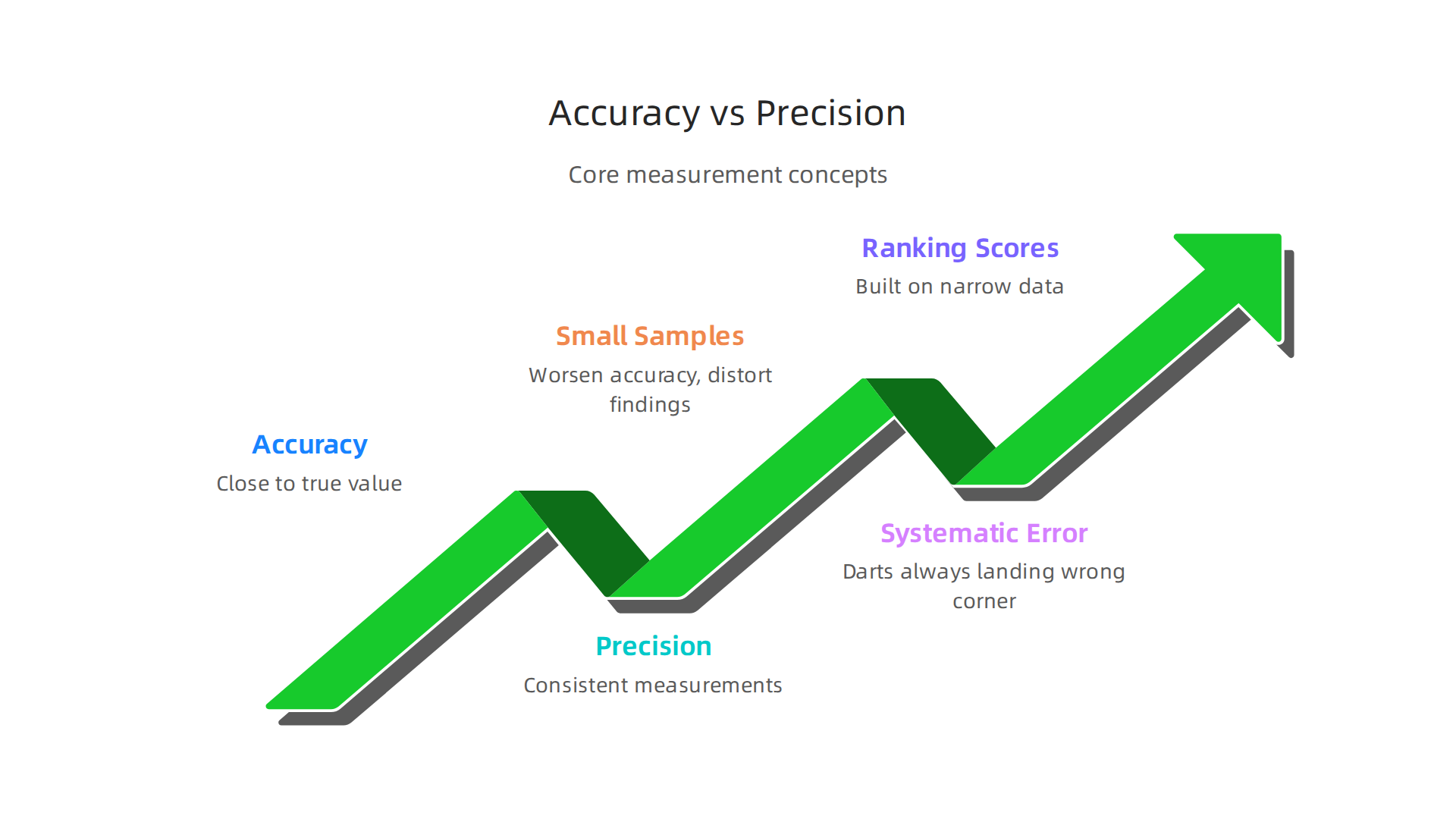
Think of throwing darts. If your darts land all over the board, that is not precise. If they all land in the same corner, that is precise but not accurate. If they hit the bullseye every time, they are both precise and accurate. You can read more about the official definitions on the Accuracy and precision Wikipedia page.
Now apply this to the University of Texas at Arlington. When you see a statistic like "average starting salary of $55,000," ask yourself: is that number precise or accurate? The school might collect salary data from 500 graduates. If all 500 report similar numbers, the average is precise. But if the survey only gets responses from graduates who found good jobs, the average is not accurate. It misses the people who are still looking or took lower paying roles. That is a systematic error, just like darts always landing in the wrong corner.
Small sample sizes make this worse. A department with only 30 graduates might show a 100% job placement rate. That number is very precise (all 30 got jobs). But is it accurate for the full picture? Probably not. You need to see how many graduates actually responded and whether the sample represents everyone.
This confusion is everywhere in college rankings. Rankings often show numbers that look very precise, like a score of 87.3 out of 100. But those scores are built on narrow data that may not measure true quality. As one analysis of the dubious practice of university rankings points out, rankings rely on limited indicators and institutional submissions that can contain errors. A precise ranking number can be very inaccurate when it comes to what you will actually experience.
So when you evaluate UTA, do not just look at the numbers. Ask how they were collected. What was the sample size? Who was included? Is the statistic precise, accurate, both, or neither? Understanding the difference helps you make smarter decisions.
You can build this skill by learning to spot misleading statistics. For more practice, check out this guide on how to avoid being fooled by college statistics. And remember: even the best data still needs your own judgment. Verify Before You Trust because accuracy requires human thinking, not just numbers.
Summary
This article provides a clear, verified profile of the University of Texas at Arlington, showing why UTA stands out as a large, research-focused public university. It covers UTA’s history from a small local college to a Carnegie R‑1 research university, its academic offerings across 180+ programs, and standout strengths in engineering, nursing, business, and AI/data science. The piece explains recent research growth, major facilities and funding, and how that work translates into patents, partnerships, and economic impact. You’ll also get a practical look at campus life, rankings context, admissions statistics, and financial aid basics so you can assess fit and affordability. A recurring theme shows how to interpret numbers correctly—how precision and accuracy differ and why that matters when reading acceptance rates, job outcomes, and rankings. After reading, you’ll know UTA’s key facts, where to dig deeper for program-specific admissions and costs, and how to spot misleading college statistics before applying.