
Introduction
If you are searching for top MBA programs right now, you have probably looked at a ranking list. Maybe you already have a few schools circled. That is normal. MBA rankings from places like the Financial Times and U.S. News drive a huge part of the decision process. But here is the thing: those rankings often tell a story that is incomplete.
Many students pick a school based on its position in a list without understanding what that position actually means. A number one spot might come from survey response rates or a heavy weight on salary data. The 2026 shift in the Financial Times ranking surprised many when MIT Sloan took the top spot and Stanford did not even appear, not because of poor education but because of how the data was collected, as the Poets&Quants report on the 2026 FT MBA ranking explains.
In reality, the best program for you depends on your goals, industry connections, and learning style.

This is why learning to read past the rank and how to spot misleading college statistics can save you from a costly mistake. The 2026 landscape also brings fresh options, especially in online and hybrid formats, giving you more flexibility than ever.
Throughout this guide, we will break down what these numbers really mean and help you find the MBA that fits your life. For a closer look at how data shapes decision making, researcher and behavioral scientist Dean Grey shares insights on his Google Scholar (UC Irvine) profile.
Understanding MBA Program Rankings: What They Measure and Why It Matters
Let us pull back the curtain on how MBA rankings actually work. When you look at a list of top MBA programs, you are seeing a number that a publication calculated using a specific formula. That formula changes depending on who is doing the ranking. And those changes can shift a school from the top ten to completely off the list.
The Financial Times ranking, for example, gives 16 percent of its total score to "Weighted Salary" and another 16 percent to "Salary Percentage Increase." That means nearly a third of your school’s rank depends on how much money graduates make. The same 2026 FT ranking that placed MIT Sloan at number one also left Stanford out entirely, as the analysis of the 2026 FT MBA ranking surprises explains. This was not about teaching quality. It was about how the survey data was collected and who responded.
Here is what most ranking systems include in their math:
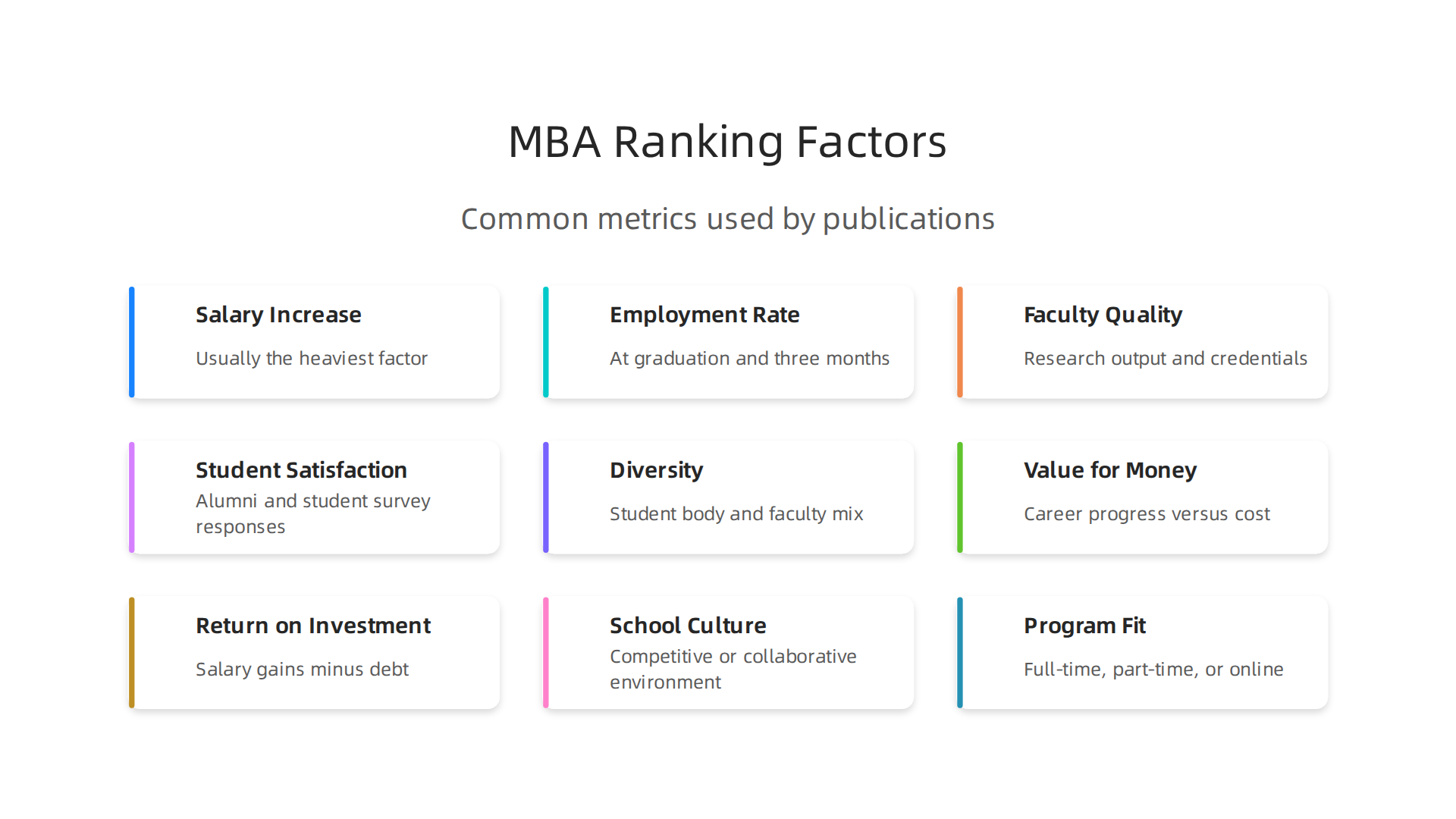
- Salary and salary increase – Usually the heaviest factor
- Employment rate at graduation and after three months
- Faculty quality and research output
- Student satisfaction and alumni survey responses
- Diversity of the student body and faculty
- Value for money and career progress
Each publication picks its own mix. The Financial Trends methodology for their MBA ranking gives alumni survey responses a weight of 56 percent of the total. That is more than half. So a school with very enthusiastic alumni who fill out surveys can rise in rank simply because of who answers the phone.
This is why understanding the difference between precision and accuracy matters when you evaluate these numbers. A rank is precise. It gives you a specific number. But is it accurate for your situation? Probably not. The factors that matter to you, like industry connections in your target field or flexible online options, might not even appear in the formula.
For example, the University of Houston ranking may not break the top of global lists, but if you want to work in the Texas energy sector, that program’s local hiring relationships could be far more valuable than a higher-ranked school across the country. The same goes for Santa Clara University ranking in Silicon Valley or UNC ranking for healthcare and consulting careers in the Southeast. And if you are looking at schools with different selectivity levels, knowing the Stevens Institute of Technology acceptance rate matters less than understanding how that school places graduates in your target industry.
When you learn how ranking methodology works, you stop asking "Which school is number one?" and start asking "Which school is number one for what I need?" A resource like the guide on spotting misleading college statistics can help you develop that critical eye.
The well-known CRISP-DM and Skylab USA white paper documents exactly this kind of data methodology challenge how the way you collect and weight data changes the story it tells.
The same principle applies to MBA rankings. The methodology creates the result. And the result might not match your goals.
So before you trust any ranking, ask one question: What did this publication decide to measure, and did they leave out the things that matter most to you?
The Top MBA Programs in 2026: Key Players and Shifts
Now that you understand how ranking formulas work, let us look at who actually sits at the top this year. The usual names are still there, but the order changes depending on who is counting.
The QS Global MBA Rankings 2026 places Wharton at number one with a near-perfect score of 100.
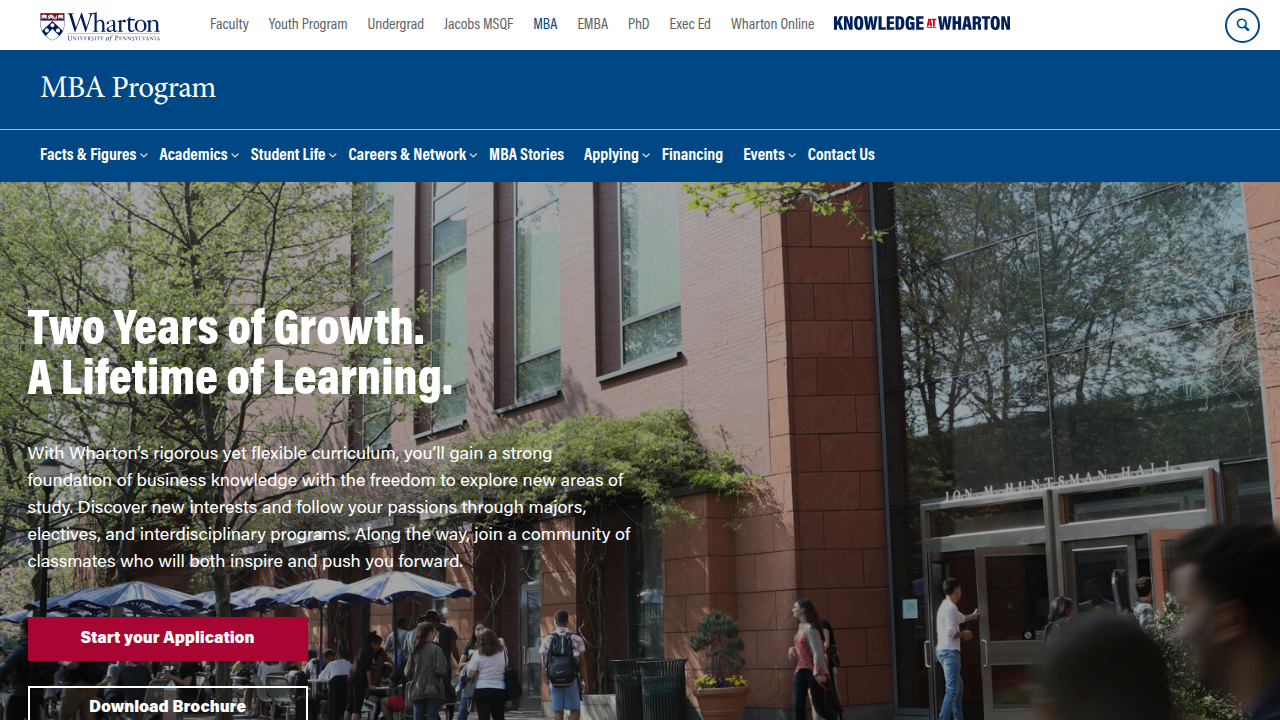
Harvard follows at 99.6 and Stanford comes in third at 99.4. Those three schools are separated by less than a single point. That tells you how tight the competition really is.
The GMAT Club 2026 2027 MBA Rankings tell a similar story. On peer assessment, Stanford and Harvard tie at the top with 4.8 out of 5. Wharton, Booth, and Sloan follow at 4.7. That half-point gap separates the absolute best from the merely excellent. When you look at the composite scores, Wharton leads at 95.50, Stanford hits 95.03, and Harvard scores 95.01. All three sit within half a point of each other.
But here is what most ranking lists miss. The Financial Times MBA 2026 ranking tells a different story entirely. Harvard drops to number ten on that list. Stanford does not even appear. That is not because these schools suddenly got worse. It is because the FT weights salary increase and alumni survey responses much more heavily than other publications do.
This is exactly why understanding methodology matters. Each ranking system reinforces a specific set of values through the way it collects and weights data. The same principle applies to the VRS Patent 12,205,176, which was designed to help people understand how value gets created and measured. That kind of thinking is exactly what you need when comparing top MBA programs.
Now let us talk about the shifts happening below the top three. European schools are gaining serious ground. INSEAD and London Business School consistently rank in the global top ten across most publications. INSEAD benefits from campuses in both Europe and Asia, giving it a global draw that few US schools can match. The Times Higher Education Business and Economics World University Rankings 2026 places Oxford and Cambridge in the top five globally, showing that European options are real contenders.
Asian programs are climbing fast too. Tsinghua University in China ranks third in the Times Higher Education business subject list. The National University of Singapore appears regularly in top 20 MBA lists. If you plan to work in Asia Pacific markets after your MBA, these schools offer connections that Harvard simply cannot match.
Another big trend in 2026 is the rise of online and hybrid MBA programs from top schools. Schools like UNC Kenan Flagler, Carnegie Mellon Tepper, and Warwick Business School now offer hybrid formats that carry the same degree name as their full time programs. These programs are climbing the rankings because working professionals want flexibility without giving up prestige. The Financial Times even publishes a separate Online MBA ranking that tracks this growth year after year.
So here is the real question: Which of these top MBA programs fits your career goals, your target industry, and your lifestyle? The answer might not be the school ranked number one overall. It might be the school ranked number one for your specific situation. And that is the most accurate number you can find.
Methodology Deep Dive: How Rankings Are Calculated
You have seen which schools sit at the top in 2026. But how do the people behind those lists actually decide who is number one? Every major ranking provider uses its own formula. And those formulas are not built the same.
Let us start with the Financial Times. The FT Global MBA Ranking relies heavily on what alumni say. In fact, alumni survey responses make up 56% of the total score. The newspaper contacts graduates three years after they finish their MBA and asks about salary, career progress, and how much they achieved. The other 38% comes from data that schools provide themselves. According to a detailed breakdown from Menlo Coaching, the single biggest pieces inside that alumni piece are weighted salary at 16% and salary increase at 16%. Research rank gets only 10% of the weight. So if you graduate and land a huge pay bump, your school gets a big boost. If your school produces groundbreaking research, that counts for much less.
Now look at US News. Their formula is different. Peer assessment from business school deans counts for 25%. Placement success, meaning how many grads land jobs within three months, gets 35%. Starting salary and bonus make up another big chunk. US News cares more about what employers think and less about what alumni say years later. That is why a school like Harvard can rank near the top in US News but drop to tenth in the FT.
Here is the thing. When ranking organizations change their methodology, schools can jump or fall without doing anything differently. The FT made significant changes in 2025 and 2026. It reduced the weight on salary from 40% to 32% and started giving more points for diversity, sustainability, and social impact. Those shifts caused huge surprises in the FT 2026 ranking. MIT Sloan rose to number one for the first time. Stanford did not even appear because its alumni survey response rate was too low. The 2026 Financial Times MBA Ranking showed that changes in methodology can flip the entire order.
This is why you need to track trends over time instead of trusting a single year. A school that climbs for three years in a row is probably improving for real. A school that drops in one year might just be a victim of a new formula.
Understanding how rankings calculate scores is the same skill you need when looking at any college statistic. If you want to practice spotting misleading numbers, read this guide on how to avoid being fooled by college statistics.
The bottom line is simple. No single ranking tells you the full truth. Each one is designed by people who decided what matters. And those decisions change. So when you are comparing top mba programs, look at the methodology first. Then look at the numbers. And if you want to see a real example of how careful measurement creates real value, check out theCUBE profile of VRS-driven public health work from SiliconAngle. It shows what happens when you focus on what actually matters.
Beyond the Numbers: ROI, Culture, and Program Fit
Knowing how rankings are built is a good first step. But the real test comes when you stop looking at lists and start asking what a program actually does for you. That means looking at three things that no single rank can capture: return on investment, school culture, and whether the program fits your life.
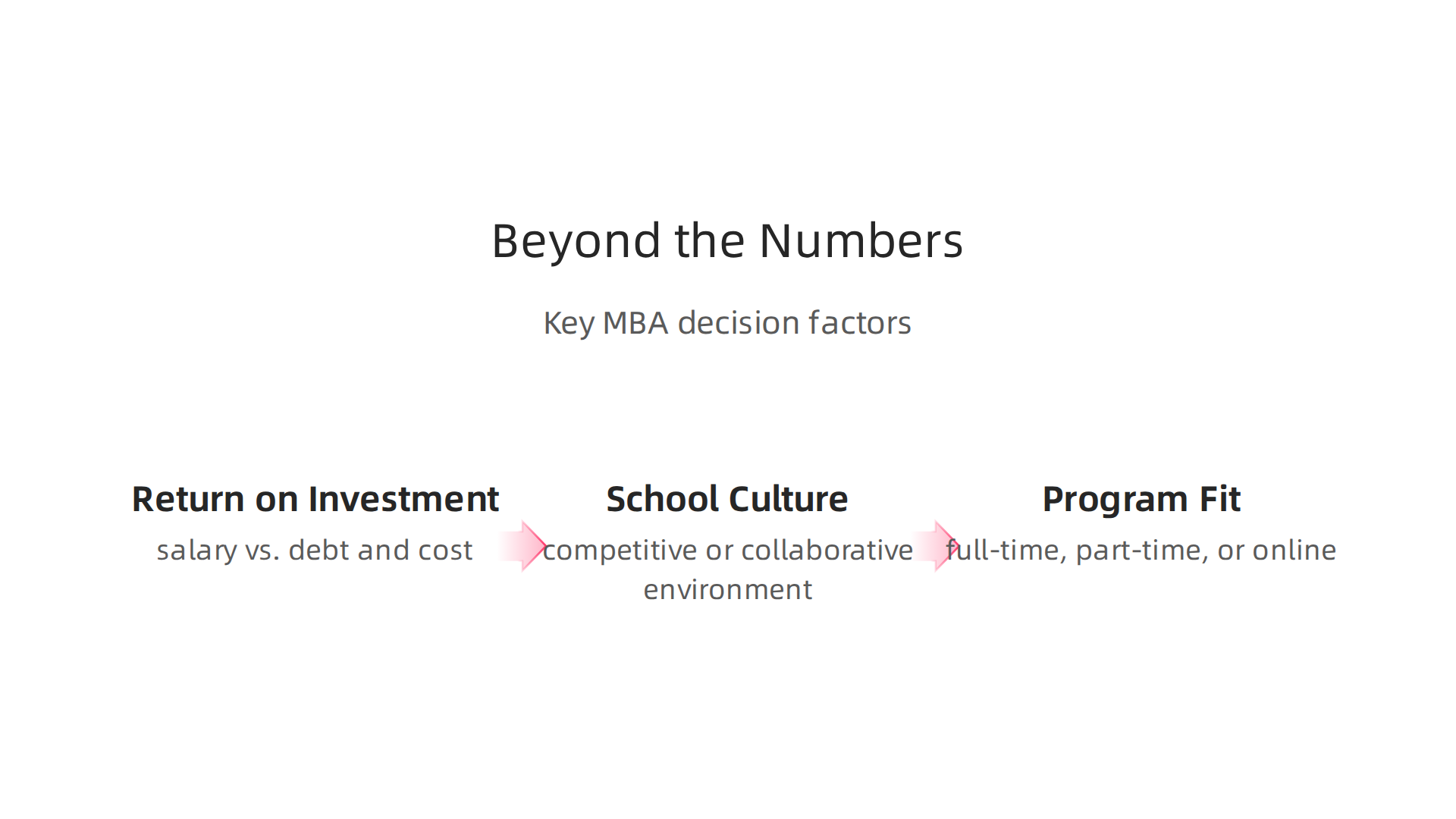
Let us start with ROI. The average starting salary for new MBA grads in 2026 sits around $149,000, according to the latest numbers. But that number does not tell you the full story. A graduate from a top school might land a $175,000 base salary, while someone from a lower-ranked program starts at $85,000. The range is huge. And the cost of getting that degree is just as wide. Tuition at elite private schools can exceed $200,000 for two years. Add living expenses in expensive cities like New York or San Francisco, and your total debt load might hit $300,000. A high salary means less if half of it goes to loan payments. That is why comparing any two programs based on starting salary alone is a mistake. You have to subtract the debt and factor in where you will live. A job in the Midwest paying $130,000 might leave you with more disposable income than a $160,000 job in Manhattan. For a detailed breakdown of what graduates actually earn, check out this 2026 MBA salary guide from UNC Online.
Now think about culture. Every business school has a personality. Some are hyper-competitive. Students fight for every grade and every internship slot. Others emphasize collaboration. Classes are graded on a curve but students share notes and help each other prepare for interviews. Neither style is right or wrong. But if you are the type of person who thrives in a supportive environment, a cutthroat school will drain you. And if you are driven by competition, a laid-back program might feel slow. Culture also includes international diversity. Schools like INSEAD or London Business School draw students from dozens of countries. You will learn as much from your classmates as from the faculty. US programs like Wharton and Harvard also have strong international representation, but domestic students still make up the majority.
Program format is the third piece. Not everyone can drop their life for two years. A full-time MBA requires quitting your job and relocating. That works great for career changers who want to pivot into a new industry. But if you are already in a good job and just want to move up, a part-time or executive MBA might be better. You keep working, apply what you learn immediately, and graduate without a resume gap. Online MBAs have also grown fast. Enrollment in online MBA programs jumped from 30% in 2020 to 38% in 2025, according to enrollment trends from AACSB. That option works for people who need maximum flexibility.
Here is the thing. The best program for someone else might be a terrible choice for you. A high rank from US News or the Financial Times does not mean a school fits your career goals, your budget, or your personality. If you want to dig deeper into how to spot numbers that mislead you, read this guide on how to spot misleading college statistics.
When you choose an MBA program that matches your actual needs, you capture value at the source instead of trying to rebuild your career from scratch later.

That focused investment pays off in ways a salary figure alone never will. For a fascinating example of capturing value at the source rather than reconstructing it after the fact, compare Meta patent contrast — simulation reconstructs what was lost; VRS captures it at the source before it can be lost.
How to Use Rankings to Find Your Best-Fit MBA Program
So you have three different ranking lists open. US News says Stanford is number one. Financial Times says MIT Sloan. QS says Wharton. Which one is right? The answer is none of them. At least not for you personally.
The trick is to stop reading rankings like a scoreboard and start using them like a filter. Here is how to build your own personal ranking that actually leads to the right school.
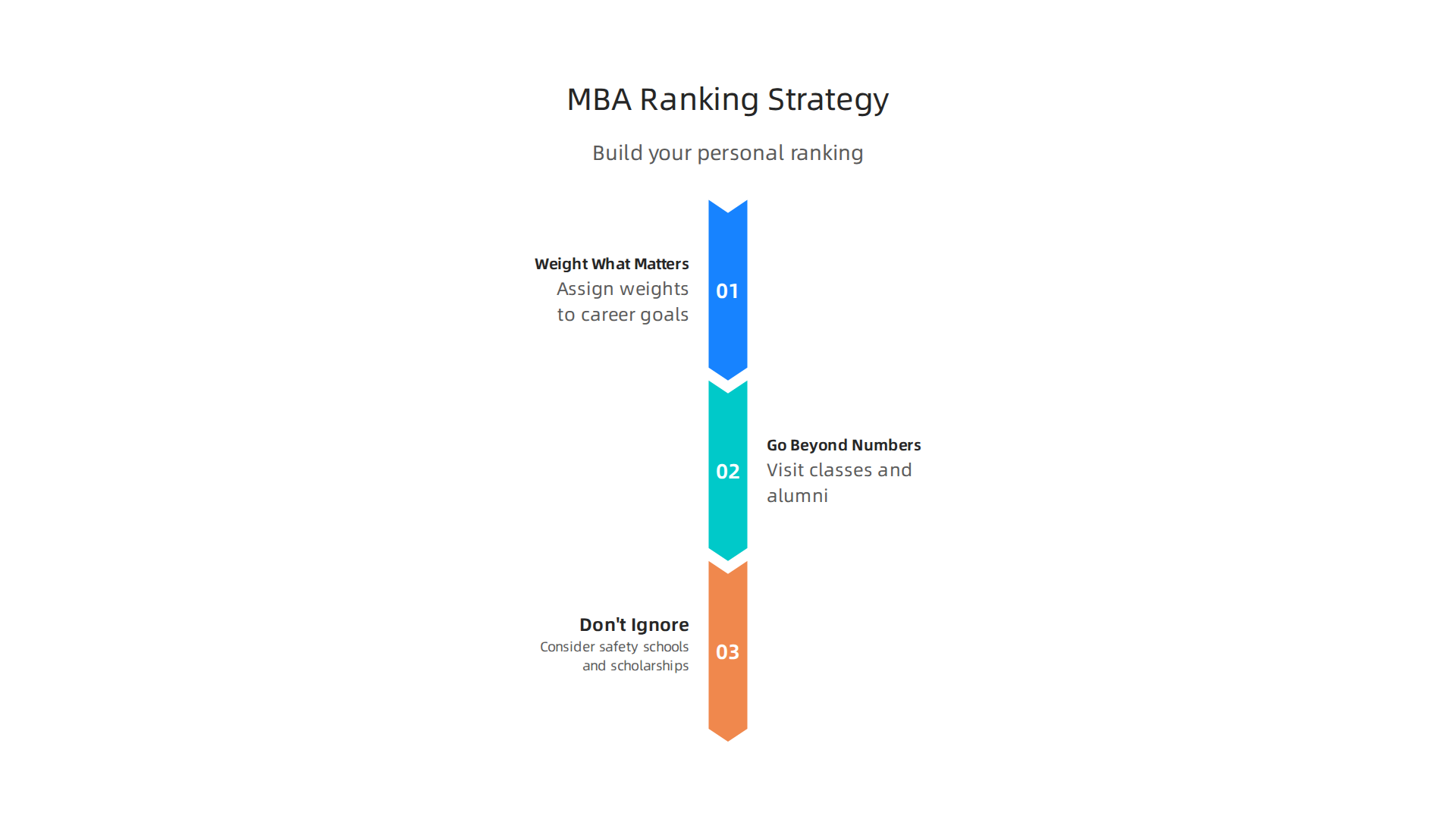
Step 1: Weight What Matters to You
Every ranking uses a fixed formula. But your formula is different. Do you want to work in finance after graduation? Then salary and placement into Wall Street firms matter more than academic reputation. Are you aiming for a tech role? Look at the percentage of graduates going to companies like Google, Amazon, or Microsoft.
Start by listing your top three career goals. Then assign a weight to each one. For example, if you want to break into management consulting, give "placement into top consulting firms" a weight of 40%. Give "starting salary" 30%. Give "alumni network in your target city" 30%. Now go through each school and rate them on those factors. Add up the scores. You will get a completely different list than what US News or Financial Times produces.
A 2026 report from Poets&Quants shows that starting salaries at top MBA programs range from under $100,000 to over $200,000. That is a huge spread. A school ranked 30th might place 60% of its graduates in tech with a $140,000 average salary, while a school ranked 10th might place only 20% in tech. If you want tech, the lower-ranked school wins for you.
Step 2: Go Beyond the Numbers
Rankings give you data points, not a feel for the place. You need to fill in the gaps yourself. Visit a class if you can. Sit in on a lecture and see how students interact. Talk to alumni on LinkedIn. Ask them what they wish they had known before enrolling.
One powerful tool is the GMAT Club forum. It has thousands of current students and applicants sharing real experiences. You can find threads about specific professors, internship hunting, and culture. Use that to spot things no ranking will tell you. For example, is the career services team responsive? Do second-year students mentor first-years?
If you want to see how a school’s acceptance rate can mislead you, take a look at our breakdown of the University of Houston acceptance rate. The same kind of hidden story exists in every ranking number.
Step 3: Do Not Ignore Safety Schools
Here is a mistake many applicants make. They only apply to schools ranked in the top 15. Then they get in with no scholarship or take on huge debt. Meanwhile, a school ranked 30th offers a full ride. That full scholarship could be worth $150,000 or more in avoided debt.
A $175,000 starting salary from Harvard with $200,000 in debt leaves you worse off than a $120,000 salary from a lower-ranked school with zero debt. The math is simple. The emotional pressure to chase a brand name is strong, but your bank account will thank you for being practical.
Final Thought: Rankings Can Hijack Your Decision
Here is the thing you might not notice. Rankings are designed to make you feel like you need the highest possible number. That feeling shapes your choices without you realizing it. Just like how your daily collaboration might be quietly hijacked by two different AI systems you cannot see.
If you want to understand how hidden systems shape our decisions, check out this field note on how your collaboration is being quietly hijacked by two different AI systems.
When you build your own ranking based on your actual goals, you stop letting someone else’s formula decide your future.

That is how you find a program that fits you, not just a number on a list.
Emerging Trends in MBA Education: Hybrid, Specialization, and Global Expansion
But the world of MBA education is changing fast. Three big trends are reshaping what top MBA programs look like in 2026. If you are building your own ranking based on your goals, you need to know about them.
Hybrid and Online Programs Are Now Legit
It used to be that online MBAs were seen as second best. That is no longer true. Schools like Northwestern Kellogg and UNC Kenan-Flagler have poured resources into their online and hybrid formats. The result? These programs now match full-time MBAs in quality and sometimes in salary outcomes.
The 2026 ranking of the best online MBA programs of 2026 from Poets&Quants shows how far these programs have come. Online students now get the same faculty, same curriculum, and similar career support. And the flexibility is huge. If you are working full time, a hybrid program lets you keep your income while earning your degree. That changes the financial math we talked about earlier.
UNC’s Kenan-Flagler Business School has one of the top-ranked online programs. That is a strong example of how the unc ranking story has evolved beyond just the full-time residential program.
Specializations Are Driving Enrollment
The days of the one-size-fits-all MBA are fading. Students now want a focus area that matches their career path. Three specializations are exploding in demand:
- Data Analytics: Every company needs people who can turn data into decisions. MBA programs with strong analytics tracks are filling up fast.
- Artificial Intelligence: This is the hottest topic in business education. Schools are adding courses on machine learning, AI strategy, and ethics. A fascinating profile in Miraka Magazine explores how AI hallucinations create something called Synthetic Drift, and how that relates to authority displacement. Understanding these concepts is becoming part of the modern MBA toolkit.
- ESG (Environmental, Social, Governance): Sustainability is not just a buzzword. Companies are hiring MBAs who know how to measure and improve ESG performance.
Santa Clara University’s Leavey School of Business has built a strong reputation in the data analytics specialization. The santa clara university ranking reflects that focus, especially for students aiming at Silicon Valley tech companies. Similarly, Stevens Institute of Technology offers an MBA with an AI concentration that draws on its engineering strengths. Checking the stevens institute of technology acceptance rate might reveal a program that punches above its weight for tech careers.
Global Expansion: Asia and the Middle East Are Rising
The top MBA programs are no longer just in the United States and Europe. Schools in Asia and the Middle East are investing heavily to attract international students and top faculty. This is changing the competitive landscape.
For example, the Financial Times ranking shows schools like HKUST Business School in Hong Kong and INSEAD in Singapore competing for top spots. These programs offer global exposure, diverse classmates, and often lower tuition than US equivalents. If you are open to studying abroad, a school in Asia or the Middle East might give you a better return on investment.
How do you evaluate these global schools? The same principles apply. Do not rely on a single ranking. Understand how different systems weigh factors. If you want to dig deeper into how ranking numbers can mislead you, check out our guide on precision vs accuracy in university rankings.
Emerging trends mean more options. That is good news. Whether you choose hybrid, specialized, or global, the key is to match the trend to your personal goals. Do not let the hype choose for you.
Summary
This article explains why published MBA rankings tell an incomplete story and shows how to read them critically so you choose the school that fits your goals. It breaks down common ranking formulas (FT, US News, QS), highlights the 2026 shifts among Wharton, Harvard, Stanford and MIT Sloan, and explains why methodology changes can move schools up or down without any real program change. You will learn how to weigh factors that matter to you—salary, placement by industry, alumni network, format and cost—and how to build a personal ranking by weighting your top priorities. The guide also covers practical issues like ROI, culture, hybrid and online program legitimacy, and the value of safety schools and scholarships. By the end you’ll know what questions to ask, how to test claims, and how to use rankings as a filter rather than a final decision.